
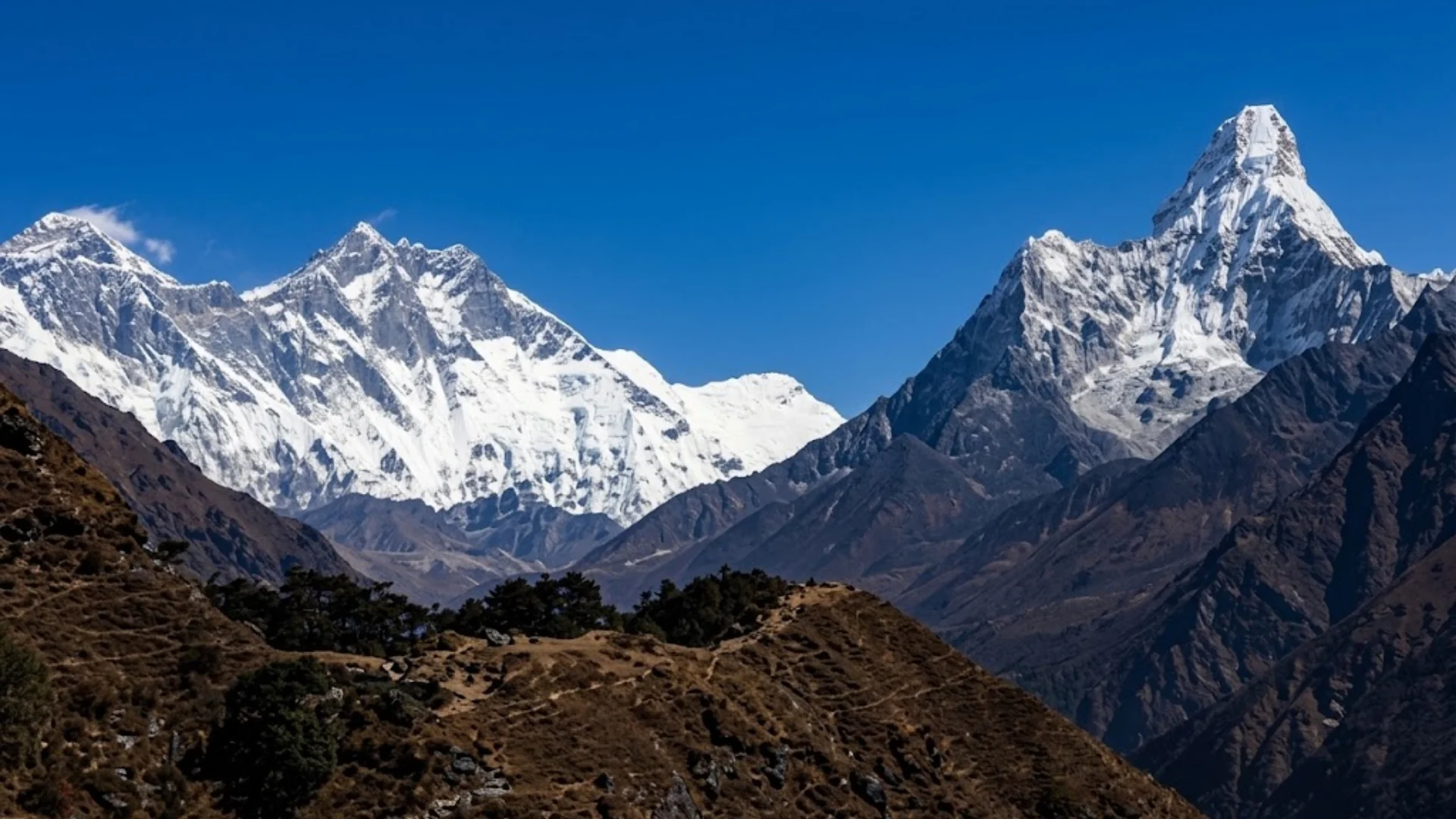
5 Star Trekking in Nepal
Table of Contents
+
Almost every trekking company in Nepal sells you “5-star luxury.” Almost none of them define it. So you end up comparing brochures, all of which say the same thing, and you book on price — which is exactly how the word 5-star became worth nothing.
This guide is different. It explains what the luxury teahouse tier system in Nepal actually is, what each tier gives you, and — the part nobody writes — where the standard physically cannot be maintained. It names the ceiling above Namche Bazaar, and it tells you exactly which questions to ask an operator before you pay them.
We run premium departures and we have an interest in you understanding what you are buying. That is also why this page is worth reading: an operator who defines their standard clearly is making a promise they can be held to.
The 5-star claim is not regulated
The first thing to understand is that there is no accreditation body for “5-star” in Nepal trekking. The star rating that governs hotels in Kathmandu does not govern the lodges you sleep in on the trail.
There is no official star classification for trekking lodges in Nepal. For practical comparison, this guide uses a five-tier framework based on factors such as room quality, bathroom access, hot water, heating, charging facilities and dining standards. Actual facilities vary by lodge, village and trekking region.
The problem is not the system. The problem is that marketing has borrowed the word “5-star” and applied it to level two.
Guide’s Note — Nepal Lion Tours. Ask for the specific lodge name and room category included at each stop. A named property and clearly stated room type tell you far more than a generic “luxury lodge” description.
The tiers, defined
Here is the actual ladder, from bottom to top. The names are informal and vary by region, but the substance is consistent.
| Tier | What it is | Room | Bathroom | Hot water | Food |
|---|---|---|---|---|---|
| 1 — Basic teahouse | A family-run lodge with two or three rooms | Single room, twin beds, thin walls | Shared, often cold | Bucket or paid shower | Dal bhat standard, limited menu |
| 2 — Standard teahouse | The default trekking lodge, 8–15 rooms | Better mattress, blankets | Shared | Paid hot shower, often solar | Wider menu, some Western items |
| 3 — Premium teahouse | A well-run lodge that has invested in rooms | Private bathroom, real beds | Private, en-suite | Reliable hot water, often included | Good menu, comfortable seating |
| 4 — Luxury lodge | Purpose-built for trekkers, often a group | Spacious en-suite, heating at altitude | Private, en-suite | Reliable hot water where facilities permit, plus charging | Best available — steaks, pasta, real coffee |
| 5 — Landmark lodge | The best property in a specific village, not a chain | The best room available, often a named room | Private, en-suite | Guaranteed, plus drying and lounge facilities | Outstanding, often with a view |
The critical point: tiers 4 and 5 exist in a handful of villages and almost nowhere else. This is the structural fact that separates an honest operator from an advertising one.
Below 2,000 m in the Annapurna foothills, the Langtang valley, and around Pokhara, you can access tier 4 routinely. Namche Bazaar has several. Above 4,000 m — Lobuche, Gorak Shep, Dingboche on some nights, upper Annapurna — the top of the range is typically tier 2 or 3, and occasionally a tier 4 in a renovated property that has a handful of rooms and books out a year ahead.
Where the ceiling drops, and why
This is the section other operators leave out, and it is the reason we publish this page.
A Kathmandu-style hotel standard is difficult to maintain at 5,100 m. The reasons are physical and economic, not a matter of spending more:
Infrastructure. Higher-altitude villages have more limited water, electricity, heating and wastewater infrastructure than Kathmandu. In parts of the Khumbu, power comes from local hydropower or other limited systems, while water and other supplies require additional transport. These constraints make it much harder to maintain the facilities associated with a conventional high-end hotel.
Supply. Construction materials, equipment, food and replacement parts become increasingly difficult and expensive to transport as altitude and remoteness increase. In the higher villages, many supplies must be transported by porter, pack animal or other available means. Maintaining high-end accommodation therefore becomes considerably more challenging than at lower elevations.
Seasonality. Many higher-altitude lodges reduce operations or close during the winter months, while those that remain open may operate with more limited services. Heating, hot water and electricity can be affected by weather, water availability and local infrastructure. This means accommodation standards can vary significantly by season.
The consequence you should understand: on a standard Everest Base Camp trek, accommodation generally becomes more basic as you move higher above Namche Bazaar. The exact standard varies by village, lodge and season, but private en-suite facilities become less consistently available at higher elevations. This is a limitation of the route and local infrastructure rather than something an operator can completely eliminate through pricing.
Guide’s Note — Nepal Lion Tours. This is why our premium Everest departures are built to be honest about it. We secure the best available room at each stop and the best available lodge, and where the village cannot deliver a private bathroom we say so in the itinerary rather than selling it and disappointing you at 4,900 m. A premium trek that tells you the ceiling is 3 at Gorak Shep is more useful to you than one that quietly promises otherwise.
The eight questions that separate real premium from brochure premium
Before you pay anyone, ask these. The answers tell you more than any rating.
1. Which specific lodge at each stop?
A real premium operator names properties. “Best available at the time” means nobody has checked. Ask for the name at each of the highest-altitude stops specifically.
2. Is the bathroom private or shared, at the top of the route?
The single most useful question. If the answer is vague, the answer is shared.
3. Is hot water included, or charged per shower?
Charged per use at a premium rate is common even at good lodges. Know before you go.
4. How many trekkers per group?
Above Namche, room supply is the constraint. Groups of eight plus a guide need more lodge capacity than groups of four, so your room quality depends on the group size.
5. What happens if the lodge is full?
A good operator has a named alternative and a policy. A bad one says it will never happen.
6. Is the guide licensed, and who is it?
Government-licensed, and ask to see the licence. On premium trips you should know your guide’s name before you land.
7. Do you provide a duffel, or do I carry my bag?
Almost everyone provides a duffel carried by a porter. If a “premium” package expects you to carry your own pack, ask why.
8. What is excluded?
Hot showers, drinks, tips and helicopter charter are frequently excluded from “all-inclusive” pricing. Get the exclusion list in writing.
What genuinely separates a premium trip
Setting aside the star rating, here is what a premium departure actually delivers — and what it costs.
| Standard | Premium | |
|---|---|---|
| Group size | 10–15 trekkers | Maximum 8 |
| Guide | Licensed, shared attention | Licensed, named in advance, your pace |
| Lodges | Tier 2 standard | Best available room, private bathroom where the village allows |
| Trailhead transfers | Shared vehicle | Private, included |
| Main duffel | Carried by porter | Carried by porter |
| Gear provided | Sleeping bag, down jacket | Sleeping bag, down jacket, duffel, map |
| Water | Often buy your own | Purified drinking water on the trail |
| Helicopter access | Not available | Available on request — Everest, Annapurna, Langtang, Pokhara |
| Pace | Fixed group schedule | Set by you |
| Contact | Office hours | Same person, before and during |
The helicopter point deserves expansion because it adds flexibility to selected premium itineraries. Where helicopter services are requested, Nepal Lion Tours can coordinate helicopter arrangements for routes such as Everest, Annapurna and Langtang, subject to aircraft availability, weather, operating conditions and the requirements of the itinerary. This can allow selected treks to combine a high-altitude walking experience with a helicopter return or transfer where practical.
Choosing your tier honestly
If you are deciding what to book, match the tier to the route rather than expecting the same standard everywhere.
| If you want… | Best route | Realistic tier |
|---|---|---|
| True 5-star throughout | Poon Hill, Annapurna Panorama, lower Annapurna | 5 at most stops |
| Premium with a helicopter edge | Annapurna Base Camp, Langtang | 3–4, with helicopter in or out |
| Landmark lodges on Everest | Everest View Hotel route | 5 at the Everest View Hotel night |
| The summit itself | Everest Base Camp | 3–4 at best, dropping above Namche |
| Genuine wilderness | Annapurna Circuit, Manaslu | 2–3 — remoteness and luxury are opposites |
| Deep culture, mild comfort | Langtang, Tamang heritage trails | 3 |
The Everest View Hotel point is worth expanding. It sits at 3,880 m and is a landmark property with panoramic views toward Everest. A 6- or 8-day itinerary that includes it can provide one of the Khumbu’s highest-end hotel experiences, without requiring the same accommodation compromises found at higher elevations. It is a real trade-off, and it is a choice rather than a compromise.
Premium treks worth considering
Our premium departures, arranged by what they actually deliver rather than by days:
Everest Base Camp Luxury Trek — 10 days to 5,555 m with Kala Patthar. The full high-altitude route with private transfers and the best available lodge at each stop. Standard from USD 2,612.50 per person.
Everest View Hotel Luxury Trek — 6 to 8 days reaching the one genuine 5-star night in the Khumbu, without committing to base camp altitude. The choice of Everest itself matters more than the summit.
Everest Base Camp Trek with Helicopter Return — the full trek out, flown back from Gorak Shep. Saves two days of descent and is only possible with in-house helicopter operations.
Ghorepani Poon Hill Luxury Trek — 6 days, and the easiest route to a genuine high tier. Poon Hill at 3,210 m with Annapurna South, Machhapuchhre and Dhaulagiri in view. Standard from USD 750.50 per person.
Gokyo Lake Luxury Trek with Helicopter Return — the quieter high-altitude option, with the Gokyo lakes and a helicopter return.
Annapurna Circuit Luxury Trek — 14+ days through Thorong La at 5,416 m. The most demanding premium itinerary we run, and the least comfortable above 4,000 m.
Also worth noting: we have operated since 2010, run a maximum of 8 trekkers per group, and our guides are wilderness first-aid certified with emergency oxygen and 24/7 support. Those are the specifics we would want to be judged on if we were choosing an operator.
Talk to us about your trip
Tell us which route you are considering and what standard you have in mind, and we will tell you honestly what the achievable tier is at each stop — including where it drops below Namche. We would rather you book the right trip than the most impressive-sounding one.
Send your preferred travel date and group size through the booking form or WhatsApp at +977-9851039020. Private departures run from two trekkers.
Frequently Asked Questions
Q. What does 5-star trekking in Nepal actually mean?
+
“5-star trekking” is not an official or regulated trekking-lodge rating in Nepal. In this guide, the term describes the highest level of accommodation and service realistically available on a particular route. This may include a private en-suite room, reliable hot water where facilities permit, comfortable bedding, charging facilities, better dining and a well-managed lodge. Standards vary by village, altitude and route, so a true luxury experience at 2,000–3,500 m may not be possible at 5,000 m.
Q. Is 5-star accommodation available on the Everest Base Camp trek?
+
Only on parts of the route. Lower-altitude stops and places such as Namche Bazaar can offer higher-end lodges, while accommodation becomes more basic as you move toward Lobuche and Gorak Shep. Private en-suite rooms are less consistently available at higher elevations because lodge capacity and infrastructure are limited. If you want a landmark luxury-hotel experience in the Khumbu, an itinerary that includes the Everest View Hotel at 3,880 m provides one of the region’s higher-end accommodation options.
Q. What is the difference between a premium teahouse and a luxury lodge?
+
A premium teahouse is generally a well-run property offering better rooms, private bathrooms where available and more dependable facilities than a basic trekking lodge. A luxury lodge usually provides more spacious rooms, stronger heating arrangements at altitude, better dining areas, charging facilities and a higher level of service. The exact facilities vary by property, so it is better to check the specific lodge and room category than rely on the word “luxury” alone.
Q. Can I get a private bathroom on a luxury trek in Nepal?
+
Private bathrooms are available on many lower-altitude and premium trekking lodges, but they cannot be guaranteed at every stop on a high-altitude route. Above roughly 4,000 m, en-suite rooms become less consistently available because the number of suitable rooms is limited. If a private bathroom is important to you, ask your operator to identify which specific nights include an en-suite room before booking.
Q. Are hot showers included on luxury treks in Nepal?
+
It depends on the lodge and itinerary. At higher-end properties, hot showers may be included, while other lodges charge separately, particularly at higher elevations. Shower availability can also depend on water, electricity and local infrastructure. Ask whether hot showers are included at each major overnight stop rather than assuming they are covered by the package price.
Q. How much does a luxury or 5-star trek in Nepal cost?
+
There is no single price because the cost depends on the route, duration, accommodation, group size, transfers and additional services. At the time of this page’s September 2026 review, Nepal Lion Tours’ premium departures range from around USD 750 for selected lower-altitude treks to USD 2,600+ for an Everest Base Camp luxury itinerary. Check the individual package page for the current price and inclusions.
Q. What is the best time for a luxury trek in Nepal?
+
For many popular trekking regions, October–November and March–April offer favourable combinations of clearer weather, comfortable daytime conditions and good trail access. October and November are particularly popular for clear mountain views, while spring brings warmer conditions and rhododendron blooms at lower elevations. The best month also depends on the route, altitude and your priorities.
Q. Is a helicopter return available on a luxury Everest trek?
+
Some luxury Everest itineraries can include a helicopter return from the upper Khumbu, depending on the route and current operating conditions. A helicopter return can shorten the walking descent and reduce the number of days spent at high altitude, but availability depends on weather, aircraft availability, landing conditions and applicable operating requirements. Ask your operator exactly where the helicopter would collect you and what happens if the flight cannot operate.
Q. Do I need a guide for a luxury trek in Nepal?
+
Guide and permit requirements depend on the trekking region and route. Many popular trekking routes have specific guide, permit and registration requirements, while the Everest region has its own local entry arrangements. Nepal Lion Tours includes a licensed English-speaking guide on its trekking departures and can confirm the applicable requirements for your exact itinerary before departure.
Q. Which Nepal trekking routes are best suited to luxury accommodation?
+
Luxury accommodation is generally easier to arrange on routes with established trekking infrastructure and better-developed lodges. Lower-altitude sections of the Annapurna, Everest and Langtang regions can offer higher-end accommodation, while more remote and higher routes naturally have fewer premium properties. If accommodation quality is your main priority, discuss the lodge standard at every overnight stop rather than choosing a route based only on its “luxury” label.
Q. Can I get luxury accommodation throughout the Everest Base Camp trek?
+
A high-end accommodation standard can be arranged at selected stops, but the same level cannot realistically be guaranteed throughout the entire Everest Base Camp route. Accommodation choices become more limited as you move higher, particularly around Lobuche and Gorak Shep. A premium operator should tell you where private rooms and en-suite bathrooms are available and where shared facilities may be necessary.
Q. Is a small group better for a luxury trekking experience?
+
A smaller group can make premium accommodation logistics easier, particularly on routes where the number of higher-quality rooms is limited. It can also allow more flexibility in walking pace and group arrangements. However, the actual accommodation standard still depends on the lodge's available rooms, so group size should be considered alongside the specific properties included in the itinerary.
Q. What should I ask before booking a 5-star trek in Nepal?
+
Ask for the specific lodge name at each overnight stop, the room type included, whether the bathroom is private, whether hot showers are included, the maximum group size, what happens if the preferred lodge is full, and which services are excluded from the price. These details provide a much clearer picture of the actual trekking experience than a generic “5-star” or “luxury” label.
Admin
A passionate explorer and writer dedicated to sharing authentic stories, local insights, and expert travel guides from the heart of the Himalayas.
No comments yet
Be the first to share your thoughts and experiences on this story!