
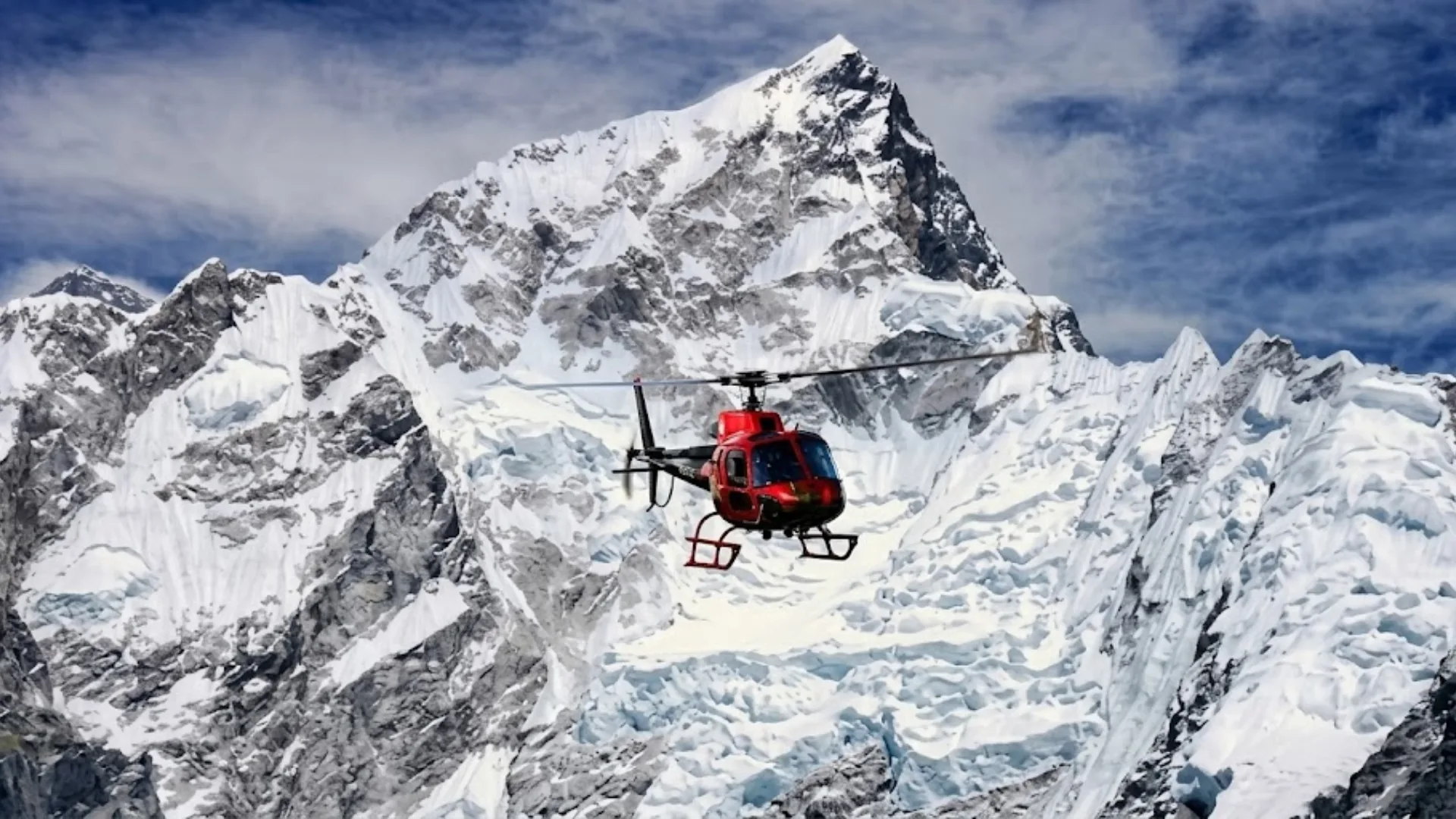
Everest Helicopter Tour: What It Costs, How It Works & What to Expect
Table of Contents
+
Before breakfast, you are in Kathmandu. Hours later — if your tour includes it — you are standing on the black-rock ridge of Kala Patthar at 5,545 metres, with the south face of Everest rising directly ahead and the Khumbu Glacier below. By mid-day you are usually back in the city, and the only thing that feels real is the memory.
That is the Everest helicopter tour, in its full version: from Kathmandu streets into the high Khumbu and back in a single morning. It is the fastest and most comfortable way to see Everest close — no two-week trek, no acclimatisation grind, no teahouse nights. It is also, for first-timers especially, easy to book badly. This guide covers the full reality: the route and timeline, what the Kala Patthar landing involves, what a 2026 Everest helicopter tour costs in its different forms, what is and is not included, the safety realities, and how to book the version that matches what you actually want.
What Is an Everest Helicopter Tour, Exactly?
There are two products sold under similar names, and they are different:
The Everest scenic flight (fixed-wing plane) flies at high altitude past the mountain range, giving window views of the peaks from around 7,000–8,000 metres — without ever landing in the Khumbu. It is aerial viewing only.
The Everest helicopter tour lands in the Everest region. Sightseeing itineraries make a ground stop at the Hotel Everest View and, on the flights that include it, at Kala Patthar itself. You step onto Himalayan ground at 5,545 metres. That difference is everything: one is a film, the other is a place you have been.
Two further distinctions within helicopter tours:
- Shared flight — you book a seat; the helicopter carries up to five passengers; departure follows the group.
- Private charter — the aircraft is yours; you choose the timing, the routing and the pace.
And two landing options, which operators sell under different packages:
- Overfly with hotel stop — you fly over Everest Base Camp and the Khumbu glacier, and the helicopter lands at the Hotel Everest View for breakfast.
- Kala Patthar landing package — the same scenic route with a short touchdown at 5,545 metres added, where weather and operating conditions permit.
A clarification on the name: “Everest Base Camp” in a tour title describes what you fly over. As a rule, commercial sightseeing itineraries do not land at Base Camp itself — the site sits on a moving glacier, the direct view of the summit from the glacier floor is blocked by the southern ridges, and landings there are restricted during the spring climbing season. Expedition-support flights are a separate category, arranged for specific operations. For a helicopter sightseeing tour, the viewpoint used for a landing is Kala Patthar — it exists precisely because it offers the panorama Base Camp cannot. Most operators sell the Kala Patthar landing as an upgrade or as an all-inclusive package option; some overfly tours skip it entirely. Confirm which product you are buying before you pay — it is the difference between seeing Everest from a moving window and standing in front of it.
The Route and Timeline: A Morning in the Khumbu
The schedule below is an illustrative itinerary, not a guaranteed timetable. Departure, landing and return times vary with weather, aircraft operations, passenger weights, fuel stops and the day’s flight arrangements. Confirm the expected duration and the contingency plan with your operator before booking.
| Time (approx.) | Leg | What happens |
|---|---|---|
| 5:00–5:30 AM | Hotel pickup | Private vehicle to the domestic terminal at Kathmandu airport |
| 6:00–7:00 AM | Check-in & briefing | Weigh-in, safety briefing, weather go/no-go decision |
| ~7:00 AM | Kathmandu → Lukla | Flight east along the Dudh Koshi valley, terrain rising to Lukla (2,860m) |
| ~7:45 AM | Lukla stop | Technical stop at Tenzing-Hillary Airport: refuelling and final weather check |
| ~8:10 AM | Lukla → Khumbu | Over Namche Bazaar (3,440m) and Tengboche; Ama Dablam, Lhotse, Nuptse open up |
| ~8:35 AM | Pheriche shuttle | Brief stop; aircraft may split pax into smaller groups for the high-altitude leg |
| ~8:50 AM | Kala Patthar | 10–15 minutes on the ground at 5,545 metres, conditions permitting |
| ~9:10 AM | Hotel Everest View | 30–45 minutes: breakfast on the terrace at ~3,880m |
| 9:30–10:30 AM | Return via Lukla | Refuel if needed, then the flight back over the Himalayas |
| ~11:15 AM | Airport arrival | Land at Kathmandu domestic terminal, then vehicle transfer to your hotel |
| ~11:45 AM | Hotel drop-off | Back in the city around lunchtime, conditions permitting |
The structure is constant across operators: up before dawn, the drama of the Khumbu contained before midday, the afternoon free. That is the appeal of the format — and the reason early hotel pickups exist at all.
Understanding the schedule from the operator’s side
Three real-world variables explain why advertised times drift:
- Weather decisions are made at the airport by the operating crew, not by your agent. Clear at 6:00 AM can mean fog at Lukla by 7:30; the crew holds or cancels accordingly, under strict operating rules.
- The Pheriche stop is a standard weight-management step on high-altitude legs (see Safety), not an itinerary extra.
- Fuel stops at Lukla are technical, and your position in the airport’s departure order can shift your actual takeoff time.
Any operator you book with should give you their own expected times for your departure date — treat day-of flexibility as a feature, not a flaw.
The Kala Patthar Landing: The 15 Minutes That Matter
At 5,545 metres, the helicopter sets down on a small cleared ridge. The approach is deliberate — at this altitude the air is thin, the rotors work harder, and the landing sequence is slower and more careful than anywhere else on the route.
What you feel first is the altitude: even standing still, you are slightly breathless within the first minute. The wind on the ridge can be real, so your jacket and gloves go on before the door opens. And then the view does what no photograph prepares you for: the south face of Everest rises directly ahead, its summit only a few horizontal kilometres away, the Khumbu Icefall glowing below while Lhotse and Nuptse hold the flanks and Pumori and Ama Dablam close the ring.
Ground time is strictly capped at 10–15 minutes. A word of honesty about altitude: Kala Patthar is at 5,545 metres, where the air contains less available oxygen than at lower elevations. Even a short landing can cause breathlessness, dizziness or other altitude-related symptoms, and the risk varies from person to person. Follow the pilot’s and crew’s instructions, keep the stop within the permitted time, and get back aboard promptly if you feel unwell. Do not assume that a brief visit makes altitude exposure risk-free — it is a short, managed exposure, and managing it is precisely why the cap exists.
Then the helicopter drops to ~3,880 metres at the Hotel Everest View — one of the world’s highest-altitude hotels (its own published elevation is 3,880m) — for the second half of the story: breakfast on the terrace, Ama Dablam framed like a photograph, and 45 unhurried minutes to let the morning settle.
How Much Does an Everest Helicopter Tour Cost in 2026?
Prices below reflect published operator rates checked on 6 October 2026. They are indicative rather than guaranteed quotes; seasonal demand, fuel costs, aircraft availability, landing arrangements and passenger numbers can change the final price. Reconfirm the current rate before booking. They are list prices, not quotes, and they change with season, fuel and availability — re-verify with your operator before booking.
| Option | Published 2026 range (USD) | What the range covers | Landing / breakfast status |
|---|---|---|---|
| Shared seat — overfly with hotel stop | 1,150–1,500 per person | Flight, pilot, permits, transfers, oxygen, insurance | Kala Patthar not included; breakfast usually billed by the hotel (~USD 40) |
| Shared seat — Kala Patthar landing package | 1,400–2,100 per person | Same as above, plus the 5,545m touchdown where conditions permit | Landing included where permitted in this package; breakfast usually extra |
| Private charter | 4,500–6,500 per helicopter | Whole aircraft (up to 5 passengers), flexible timing, full route | Landing and breakfast terms vary — confirm in the written quote |
| Curated “luxury” helicopter day | 7,500–10,000 per helicopter | Indicative bundled figure: helicopter plus premium ground elements (guided touring, hotels, transfers) | Not a single-flight price — verify package contents before comparing |
Two patterns explain seemingly large gaps between operators quoting “$1,199” and “$1,700”:
1. Landing inclusions. A headline price usually means the overfly product. Add the Kala Patthar landing package where it is sold separately (roughly USD 300 per person at some operators, or USD 1,800 all-inclusive equivalent at others) and the gap closes.
2. Season. Clear-weather months cost more. Published 2026 figures show spring shared seats at roughly 1,400–1,600 against 1,150–1,250 in winter, because demand concentrates where visibility is reliable.
What’s typically included — and what to confirm separately
A fair comparison looks at the list, not the number:
| Item | Status | Comment |
|---|---|---|
| Helicopter flight, high-altitude pilot | Included | Confirm the operator identity and aircraft type in writing |
| Landing fees & permits | Included | Park entry is ~NPR 3,000 per the national fee schedule; local municipal landing fees may apply depending on your landing sites — confirm in the quote |
| Hotel pickup & drop-off in Kathmandu | Included | Domestic terminal transfer |
| Emergency oxygen & flight insurance | Included | Confirm the insurance wording for passengers |
| Breakfast at Hotel Everest View | Usually extra | ~USD 40 at the hotel’s own menu, billed separately |
| Gratuities (pilot, crew) | Extra | Discretionary |
| Itinerary add-ons & custom stops | Extra | Confirm price and feasibility before agreeing |
The two lines that sort professional operators from price-sellers: (a) is the Kala Patthar landing included in your price or sold as an upgrade, and (b) who pays for the breakfast. Get both in writing.
Shared vs Private: How to Choose
| Shared seat | Private charter | |
|---|---|---|
| What it is | A booked seat on a scheduled departure, up to 5 passengers | The entire aircraft and crew reserved for your party |
| Price | 1,150–2,100 per person | 4,500–6,500 per flight |
| Timing | Fixed departure window, joins the day’s group | Your choice of window, within weather and approvals |
| Kala Patthar landing | Usually an option or upgrade — confirm | Where conditions permit |
| Suits | Solos, couples, anyone comparing per-person cost | Families, photographers, celebrations, guaranteed privacy |
A practical note on value: for groups of four or five, compare the full private-charter quote against the combined cost of shared seats. Depending on the final price and what each quote includes, a charter can cost roughly the same per person while giving your group the whole aircraft — but that math only holds on confirmed numbers, so do the comparison on actual quotes, not advertised starting prices.
Everest Helicopter Tour vs Scenic Flight vs Trekking
The helicopter tour is not the only way to see the mountain, and each option suits a different traveller. Figures below are published 2026 values; trek costs span a wide operator-dependent range.
| Everest scenic flight (plane) | Everest helicopter tour | Everest Base Camp trek | |
|---|---|---|---|
| Duration | ~1 hour | 4–6 hours incl. transfers | 12–16 days |
| Highest point reached | ~7,000–8,000m in the air | 5,545m on the ground (Kala Patthar) | ~5,550–5,650m by foot |
| Set foot in the Khumbu | No | Yes | Yes |
| Everest view | From altitude through a window | Kala Patthar panorama + hotel terrace | The hard-won ground view |
| Cost (2026 published) | ~USD 250–350 | 1,150–2,100 shared / 4,500–6,500 charter | ~1,350–1,500 standard; far more for premium lodges |
| Best for | Aerial viewing without ground time | Short stays, families, first-timers, comfort | The physical journey itself |
The helicopter is not a shortcut substitute for trekking, nor the trek a “harder version” of the flight — they are different products: one compresses distance, the other is a journey in itself. Many travellers choose both at once: trek in, helicopter out. A one-way helicopter from Lukla back to Kathmandu (published at ~USD 600 per person) turns a 16-day round trip into a 13-day one. If you will never walk the valley at all, the helicopter tour is the entire Everest experience in a morning.
When to Book: Best Time, Weather and the Morning Window
Flights operate in the pre-dawn and early morning, because wind and cloud build through the day. That is mountain meteorology, not preference. The tour runs year-round in principle and lives and dies by visibility in practice:
| Season | Mountain conditions | Booking advice |
|---|---|---|
| March–May (spring) | Stable mornings, rhododendron hills, warm valleys | Peak demand; allow more lead time |
| September–November (autumn) | The clearest skies of the year | The busiest window — book the earliest |
| December–February (winter) | Clear but cold, brilliant light | Lower seat prices, quieter flights; occasional fog delays |
| June–August (monsoon) | Cloud over Kathmandu, unreliable lift window | High delay risk; many luxury itineraries route this season elsewhere |
A practical estimate rather than a fixed rule: in peak season, published availability typically runs 2–4 weeks ahead for shared seats and longer for private charters, and shortest in October–April. Ask your operator for their current availability window when you request a date. Wherever you book, confirm the weather policy in writing — a professional operator reschedules to the next clear morning or refunds if the day cancels entirely.
Is an Everest Helicopter Tour Safe?
Commercial helicopter touring in Nepal is regulated aviation. Flights operate under the oversight of the Civil Aviation Authority of Nepal (CAAN), which governs permissions for charter and non-scheduled flights, and sightseeing operators run under CAAN operating rules with safety oversight. That is the framework — the specifics of your flight should be confirmed with your charter operator in writing, not assumed from articles like this one.
Four things to confirm before you fly:
- Aircraft and operator identity. Everest tours commonly fly helicopters in the Airbus H125 (AS350) family, built for high-altitude work. Confirm the exact aircraft type and the operating company on your paperwork.
- Weight rules. Because air density falls with altitude, so does lift. Operators publish weight limits for the high-altitude leg — some published itineraries cite a combined-weight threshold around 240 kg at which the final leg to Kala Patthar is flown in two rotations of 2–3 passengers. Ask for the limit that applies to your aircraft and group, and be ready to give your weights when booking. The high-altitude shuttle that can result is a standard operational step, not a booking error.
- Insurance and oxygen. Confirm what passenger coverage and onboard oxygen your flight includes.
- Landing conditions. Landings at 5,545 metres depend on weather, visibility, wind, weight and the pilot’s judgment, under CAAN rules. “Kala Patthar, conditions permitting” is a truthful promise; “guaranteed landing” is a sales phrase.
What no operator can promise — for anyone, anywhere — is a mountain landing on a specific day. Mountain weather clears and closes on its own schedule, and the pilot’s safety call always precedes the itinerary. Book with an operator whose policy is reschedule-or-refund, and the risk concentration is entirely out of your hands.
What to Confirm Before Paying for an Everest Helicopter Tour
Before comparing prices, confirm which company operates the flight and which company handles your booking. Request a written breakdown of the itinerary, aircraft operator, landing arrangements, breakfast, permits and applicable fees.
Ask what happens if weather prevents the planned landing, whether an alternative route is offered, and what refund or rescheduling terms apply. Also confirm passenger weight requirements and what insurance coverage is included.
At Nepal Lion Tours, we recommend comparing the complete itinerary and written inclusions rather than choosing a flight based on its advertised starting price alone — it is how we evaluate the tours we arrange for our own guests.
How to Book an Everest Helicopter Tour Without Mistakes
- Decide the version first. Overfly with hotel stop, or Kala Patthar landing package? Shared or private? The four combinations price very differently.
- Get the inclusions in writing. Landing included or upgrade? Breakfast billed to the hotel? Permits covered?
- Ask about the weather policy. Reschedule to the next clear morning, or refund — in writing, before payment.
- Confirm aircraft and operator. Aircraft type and the licensed charter operator, stated on your paperwork.
- Know the weight plan. Provide group weights at booking; expect the high-altitude shuttle if your group crosses the applicable limit. It is normal.
- Check who runs it on the ground. The operator on the paperwork is who answers when weather changes your flight — our 9 questions guide covers how to verify a company before you pay.
Frequently Asked Questions
Q. How much does an Everest helicopter tour cost in 2026?
+
Published 2026 rates (checked 6 October 2026): roughly USD 1,150–1,500 per person for a shared overfly seat, USD 1,400–2,100 with a Kala Patthar landing package, USD 4,500–6,500 for a private charter of the whole aircraft (up to 5 passengers), and USD 7,500–10,000 for an indicative bundled luxury helicopter day. Breakfast at the hotel and gratuities are usually extra. Confirm inclusions and re-verify rates before booking.
Q. Do you actually land at Everest Base Camp?
+
As a rule, no. Commercial sightseeing itineraries fly over Everest Base Camp and the Khumbu Icefall and land at Kala Patthar (5,545m) instead — the site exists for the unobstructed Everest panorama. Base Camp itself sits on a moving glacier, the summit view from the glacier floor is blocked, and landings there are restricted during the climbing season. Expedition-support flights are a separate category.
Q. How long does the Everest helicopter tour take?
+
Four to six hours door to door from your Kathmandu hotel on a typical day: pickup around 5:00–5:30 AM, takeoff at 6:00–7:00, roughly 90 minutes of flying to the Khumbu, 10–15 minutes at Kala Patthar, 30–45 minutes at the Hotel Everest View, and you are back in the city by mid-morning. Times vary with weather and operations — treat the schedule as illustrative.
Q. Is the Everest helicopter tour worth it?
+
For travellers short on time, families, older visitors, or anyone who will never trek for two weeks — yes. It delivers the unclimbed Everest experience in a morning: the Kala Patthar panorama plus breakfast at one of the world’s highest-altitude hotels. If you want the physical pilgrimage, trek instead, or combine both (trek in, helicopter out). They are different products, and both are valid.
Q. Is the Kala Patthar landing guaranteed?
+
Not by any honest operator. Landings at 5,545 metres depend on weather, visibility, wind, weight and the pilot’s judgment under CAAN rules. A trustworthy operator states that the landing is included where conditions permit, and has a clear alternative (the overfly route) if weather closes the ridge.
Q. How far ahead should I book an Everest helicopter tour?
+
As a practical estimate rather than a rule: in peak season (March–May, September–November), published availability typically runs 2–4 weeks ahead for shared seats and longer for private charters, especially in October–April. Winter and monsoon seats are easier to find. Get the weather policy in writing whenever you book.
Admin
A passionate explorer and writer dedicated to sharing authentic stories, local insights, and expert travel guides from the heart of the Himalayas.
No comments yet
Be the first to share your thoughts and experiences on this story!