
What Does a Luxury Nepal Tour Cost in 2026? An Honest Price Breakdown
Table of Contents
+
Search for a luxury Nepal tour and you will find quotes from USD 499 for five days to USD 30,000+ for fourteen. Both numbers are real. Neither tells you what your trip will cost.
The honest answer to what a luxury Nepal tour costs in 2026: for a private, properly specified 10-day itinerary — named heritage hotels, private guide and vehicle, one safari, one mountain experience — published operator prices run from about USD 4,000–6,500 per person at the entry level of luxury, and from USD 8,000 upward once suites, private helicopters and premium lodges enter the itinerary. The spread is explained almost entirely by five decisions you make before anyone quotes you: trip length, hotel tier, group size, helicopter use, and who sells it to you.
This guide breaks the price apart line by line so you can read any quote — ours or anyone’s — and know exactly what you are paying for.
Luxury Nepal Tour Prices at a Glance (2026 Published Ranges)
All figures below are per person, twin-share, taken from the 2026 sources listed above.
| Trip style & length | Published 2026 range (per person) | What it usually includes |
|---|---|---|
| 7-day “Golden Triangle” (Kathmandu, Pokhara, Chitwan) | USD 6,000–8,000 | 5-star hotels, private transfers, Everest helicopter day |
| 10-day entry-level luxury, private | USD 4,000–6,500 | Named hotels, private guide and vehicle, domestic flight, shared Everest helicopter |
| 10-day fully specified luxury | USD 8,000–13,000 | Suite categories, premium lodges, extended safari, private charter options |
| 12-day multi-region (heritage + safari + trek/wellness) | USD 8,000–18,000 | Regional specialists, luxury lodges, wellness programme |
| 14-day Trans-Himalayan (Mustang, private helicopter) | USD 15,000–22,000 | Remote lodge stays, private charters, all permits |
| Luxury lodge trek, 14 days (Everest or Annapurna) | USD 3,300–18,000 | Lodge tier and helicopter terms define the spread |
| Group “luxury” departure, per day | USD 300–500/day | Shared vehicles, fixed dates, 12–16 travellers |
Three different operators can publish three different numbers for “the same” 10-day tour — USD 4,500–7,000, USD 8,000–12,000, and USD 9,000–13,000 all appear in 2026 for trips that sound identical in a headline. None of them is lying. They are pricing different trips — and the rest of this article explains the difference so you can spot it before you pay.
Why the Same 10-Day Luxury Nepal Tour Costs $4,000 or $13,000
Three real quotes, all for “a 10-day luxury Nepal tour”:
Quote A — USD 4,000. Mid-range four-star hotels (“or similar”), one shared Everest helicopter sold as a “helicopter experience”, a single guide for the whole country, breakfast only in cities, a minibus for five other passengers you never meet, and no Chitwan game drive inside the park. It is a comfortable trip. It is not the trip in the brochure photo.
Quote B — USD 7,500. Named heritage hotels in Kathmandu, a named jungle lodge in Chitwan’s buffer zone, private vehicle and driver, licensed private guide, domestic flights, one shared-group Everest flight with a named operator, all park fees, and a written weather policy. This is where most genuine luxury trips live.
Quote C — USD 12,000. Everything in Quote B, plus suite categories, a privately chartered helicopter with a Kala Patthar landing, a second safari night, a specialist cultural guide in the Kathmandu Valley, all meals, and a contingency night built in for weather.
The price gap is not margin alone. It is hotel tier, guide ratio, helicopter terms, meals, and region count.
Line by Line: What Makes Up the Price of a Luxury Nepal Tour
Accommodation: Where Luxury Changes the Price
Accommodation is the largest line in any luxury quote — and the one most often hidden behind “5-star hotels or similar.”
Published 2026 nightly rates show the spread clearly. City hotels quote per room; mountain lodges frequently quote per person on an all-inclusive basis, and tour prices convert everything to a per-person figure in the end:
| Accommodation tier | Published 2026 nightly rate | Basis | What the tier means |
|---|---|---|---|
| Comfortable upscale 4–5 star (Kathmandu, Pokhara) | USD 150–350 | per room | International standard, consistent quality |
| Heritage & boutique luxury (restored palaces, Newari architecture) | USD 150–500 | per room | Culturally specific; the tier most luxury itineraries promise |
| Remote mountain lodges (all-inclusive: meals, guided walks) | USD 200–500 | per person | Hot water, en-suite, heated rooms above 3,000m |
| Premium safari lodges (Chitwan) | USD 500–800 | per room | Private jeep safaris, naturalist guides, buffer-zone locations |
| Ultra-luxury lodges & villas (Mustang, wellness resorts) | USD 1,000–1,800+ | per room | All-inclusive programmes, villas, butler-level service |
For explicit contrast: a standard tourist hotel in Kathmandu runs USD 35–75 per night — the tier a luxury itinerary replaces, not one it should be quoting.
On a 10-night itinerary mixing city hotels with two or three nights of mountain or premium safari lodge, published accommodation subtotals run USD 2,000–4,500 per person — before guides, flights or activities. If a whole tour is quoted at USD 3,000 and the hotels are described as luxury, one of the two claims is wrong.
Ask the operator to name every property and the room category. A named hotel can be checked; “5-star or similar” cannot.
Guides and staff
A private, English-speaking licensed guide with deep cultural knowledge is published at USD 80–150 per day at the premium end (with standard licensed guiding at USD 25–40 for comparison), and the difference shows up in interpretation, decision-making when a flight is cancelled, and the relationships that open private access.
This is also where group size bites. On a shared departure, one guide for eight travellers costs each person a fraction of a private guide for two. Private touring — the defining feature of a real luxury trip — means you pay for the guide regardless of how many of you there are. Multi-region itineraries cost more here still: a cultural specialist in the Kathmandu Valley, a naturalist in Chitwan, a mountain guide in the Khumbu are three different professionals, and operators who itemise that work publish USD 300–500 per person in additional coordination costs.
Domestic flights and ground transport
Nepal’s geography makes transport a real cost, not a rounding error:
| Segment | Published 2026 rate |
|---|---|
| Kathmandu–Pokhara flight (each way) | USD 80–150 |
| Kathmandu–Lukla flight (each way) | USD 180–300 |
| Private SUV with driver, per day | USD 115–150 |
| Airport transfer in Kathmandu | USD 10–30 |
| Tourist bus Kathmandu–Pokhara (for contrast) | USD 10–23 per person |
Domestic flights save days — 25 minutes in the air against 7–9 hours of road — and luxury itineraries use them deliberately. A quote that routes everything by road to keep the headline price down is trading your days, not its margin.
Helicopter experiences: the most expensive line, and the most misunderstood
Helicopter pricing is where quotes diverge most violently, because two different products share one name:
| Helicopter product | Published 2026 range |
|---|---|
| Shared group Everest scenic flight, per person | USD 900–2,000 |
| Private Everest charter (full aircraft), per flight | USD 4,000–6,500 |
| Everest helicopter as a tour add-on, per person | ~USD 1,000–1,200 |
| Annapurna Base Camp helicopter from Pokhara, per person | USD 1,000–1,600 |
| Kathmandu–Mustang private transfer, per person | USD 2,500–4,500 |
| Fixed-wing business-class mountain flight, per person | USD 250–350 |
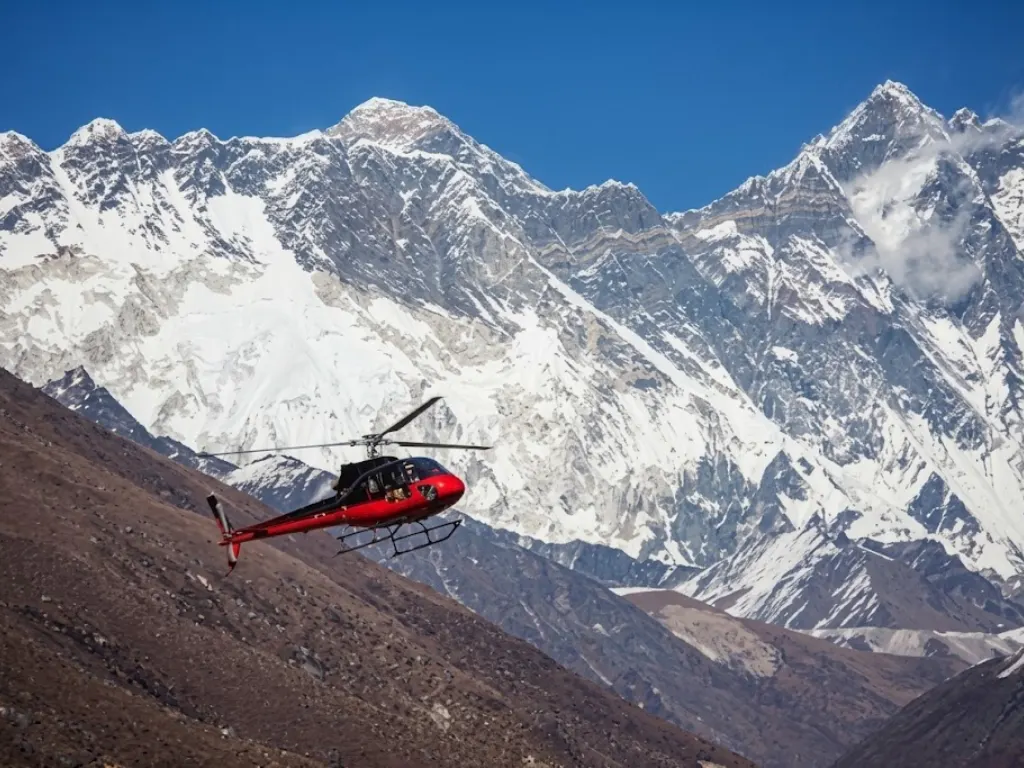
A private charter split between two travellers looks “expensive per person” on paper and is still the best value in the itinerary; a shared flight at USD 1,100 is a lower price per seat and means strangers, fixed routing and weight limits. Neither is better — but a quote that says only “Everest helicopter included” has told you nothing. Ask: shared or private, which operating company, where does it land, and what happens if weather grounds it. In our operator-choosing guide, Question 4 covers the exact wording to demand — and one clarification belongs in every quote: tour companies arrange helicopter flights through a licensed charter operator, and the paperwork should name that operator.
Permits, fees and insurance
Government fees are small relative to the trip, but they distinguish a complete quote from an incomplete one:
| Item | Published figure |
|---|---|
| Nepal tourist visa, 30 days, on arrival | USD 50 |
| Sagarmatha National Park entry (Everest region) | ~USD 22 (NPR 3,000) |
| TIMS trekking card | ~USD 15–22 (NPR 2,000) |
| Annapurna Conservation Area permit | ~USD 30 |
| Upper Mustang restricted-area permit, first 10 days | USD 500 |
| Travel insurance covering altitude, medical and evacuation | USD 100–300 |
A luxury quote should list every permit it covers individually. “All permits included” with no list is the line where a USD 500 Mustang permit goes missing.
Meals
Mountain lodges in the luxury tier are typically all-inclusive of meals; in cities, published guidance is USD 40–80 per day for top-level dining, and many quotes cover breakfast only. The rule that matters: “meals included” must say which meals, on which days. City lunches, bar bills and celebration dinners are the most common post-booking surprises — Everest Luxury Holidays’ published breakdown puts not-included extras at USD 400–1,000+ per person on a multi-region trip.
Costs Not in Your Quote: The Real Total
Plan for the following separately, whether or not the headline price mentions them:
| Extra cost | Published 2026 range | When it applies |
|---|---|---|
| International flights to Kathmandu | USD 700–1,800 economy; 2,500–5,500 business | Everyone |
| City lunches, drinks, snacks | USD 50–100 per person | Most quotes are breakfast-only in cities |
| Tips for guide, driver, porters | USD 200–400 per person | Multi-region private trips |
| Travel insurance covering your trip’s maximum altitude and helicopter evacuation | USD 100–300 | Essential for mountain itineraries |
| Single-room supplement | Varies — ask before booking | Solo travellers |
| Hot showers, charging, Wi-Fi on standard trek sections | Small per-use fees | Any trekking segment |
| Weather contingency nights | USD 100–150 per night | Helicopter- and flight-dependent itineraries |
| Optional experiences (spa, paragliding, private ceremonies) | USD 50–300 each | As chosen |
Two of these deserve emphasis. Insurance: for mountain itineraries, make sure your policy covers trekking at the maximum altitude of your trip, medical treatment and helicopter evacuation — check the policy’s altitude limit and exclusions before departure, because standard travel policies often exclude high-altitude trekking. And weather contingency is a line item because mountain flying is weather-dependent: a professional itinerary absorbs a grounded helicopter day with a planned alternative; an improvised one charges you for the extra night.
What Actually Changes the Price: Six Variables
| Variable | Lower-cost end | Higher-cost end | Effect |
|---|---|---|---|
| Group size | 4–8 sharing | Private for 2 | Private guiding is the costliest single upgrade |
| Season | Shoulder: March–April, early October | Peak: October–November, late March–May | Published shoulder-season savings: 15–25% |
| Hotel tier | International chain rooms | Heritage suites, villas | Can double the accommodation line |
| Helicopter use | Shared scenic flight | Private charter with landing | USD 3,000–5,000 swing on a 10-day trip |
| Region count | Single region (Everest or Chitwan) | Four regions with specialist guides | +USD 300–500 per person in coordination alone |
| Lead time | Booking 6+ months ahead | Peak-season late booking | Best suites and helicopter slots sell out first |
The counter-intuitive one is region count: a focused single-region luxury trip at USD 5,000–7,000 can be a better experience than a rushed four-region trip at USD 10,000. Depth beats coverage at every price point.
Local Kathmandu Operator vs International Agency: A Wide Price Gap
One observation worth knowing before you compare quotes: international luxury operators can price Himalayan itineraries at USD 12,000–25,000 per person, while Nepal-based operators may publish substantially lower prices for itineraries using similar lodges, routes and permits. The difference can reflect additional curation, overseas support, service layers and intermediary margins — not simply the cost of the Nepal portion itself.
What the higher number does buy: an international agency’s curation, its own vetting standards, and a single point of contact in your home country. What the lower number does buy: more of what you pay reaching the actual trip, and a direct line to whoever operates it on the ground when a helicopter is grounded at 6am in Lukla. Neither choice is wrong — but know which one you are making, and confirm who operates the trip either way. Question 3 of our 9 questions guide explains how to ask.
How Much Should YOU Plan For? A Decision Table
| You want | Realistic 2026 range per person | What defines it |
|---|---|---|
| Entry-level luxury, private, 10 days | USD 4,000–6,500 | Named hotels, private guide and vehicle, domestic flight, shared Everest helicopter |
| First taste of Nepal in comfort, 7 days | USD 6,000–8,000 | Kathmandu + Pokhara + Chitwan, private, one helicopter day |
| Fully specified 10 days (suites, private heli, extended safari) | USD 8,000–13,000 | Premium everywhere, on-the-ground contingency built in |
| Serious multi-region journey with wellness or trek, 12 days | USD 8,000–18,000 | Regional specialists, mountain lodges, programmes |
| Complete Nepal at the top, 14 days with Mustang | USD 15,000–22,000 | Remote lodge stays, private helicopter, all permits |
| Luxury mountain trek, 14 days | USD 3,300–18,000 | Lodge tier and helicopter terms define the spread |
| Ultra-remote set-piece (Rara charter, multi-country) | USD 8,500–30,000+ | Private expeditions, Nepal + Bhutan + Tibet combinations |
Whatever row matches you: add the “costs not in your quote” items above, and you have your real number. Your actual quote depends on dates, group size and the itinerary you specify.
How to Compare Two Quotes Without Getting Fooled
Run every quote through the same six checks:
- Hotels named, room category stated? If not, the largest cost line is unknown.
- Helicopter shared or private — with operator named? The difference is thousands of dollars.
- Meals specified per day, not per trip? “All meals” should survive a day-by-day reading.
- Permits listed individually? Especially restricted-area permits at USD 500.
- Guide model stated — private or shared, one region or several? Private guiding for two is the premium standard; a hidden group seat is not.
- Cancellation, weather and refund terms attached? A price without terms is not a price.
Then check the registration number of the company you are paying, and make sure the bank account matches it. Our full pre-booking checklist walks through all nine verification questions in detail.
If two quotes pass all six checks and differ by 30%, the lower one is probably a genuinely better deal. If they differ and only one passes, the price gap just explained itself.
The per-day sanity check
One arithmetic test cuts through any quote: divide the total by the number of days. Market listings put guided luxury travel in Nepal at roughly USD 300–500 per day per person on group departures and considerably higher on fully private itineraries. So:
- Under USD 300/day for a private trip — something is being shared, downgraded or excluded. Find out which before paying.
- USD 300–700/day private — a realistic band for named 4–5 star hotels, private guiding and domestic flights.
- USD 700–1,500/day private — suites, helicopter experiences, all-inclusive lodges and specialist guides enter the picture.
- Over USD 1,500/day — you are paying for charters, villas and ultra-luxury properties; the itemisation should show them line by line.
It is a rough instrument — remote lodge nights and charter days skew it upward — but any quote that fails the test badly will also fail one of the six checks above.
Frequently Asked Questions
Q. How much does a luxury Nepal tour cost for 10 days?
+
For a private 10-day trip, published 2026 prices start at about USD 4,000–6,500 per person for entry-level luxury — named hotels, private guide and vehicle, domestic flights, usually a shared Everest helicopter — and run USD 8,000–13,000 once suite categories, premium lodges, extended safari nights and private charter options are included. Group “luxury” departures sit lower, at roughly USD 300–500 per day per person, because guiding and vehicles are shared.
Q. Which month offers the best price for a luxury Nepal tour?
+
Published 2026 guidance puts shoulder-season travel — March–April and early October — at 15–25% below peak-season pricing, with excellent weather. October–November and late March–May are peak: best availability, highest rates, and the best suites sold 6–8 months ahead.
Q. Does a luxury Nepal tour include international flights?
+
Almost never. Published itineraries treat international flights to Kathmandu (commonly USD 700–1,800 return in economy from Europe or North America) and the USD 50 30-day arrival visa as exclusions, along with travel insurance. Always request the full inclusions and exclusions list before paying a deposit.
Q. Why do luxury Nepal tour quotes differ so much?
+
Five variables: trip length, hotel tier, private vs shared guiding, helicopter terms (shared scenic flight vs private charter — USD 900–2,000 vs USD 4,000–6,500), and whether the seller is the Kathmandu ground operator or an international reseller. Two quotes with the same headline itinerary can differ by thousands on those lines alone.
Q. Is a helicopter worth it on a luxury Nepal tour?
+
It is the single biggest discretionary line — roughly USD 1,000–1,200 per person as a tour add-on, USD 4,000–6,500 as a private charter — and it buys time and access: Everest without a two-week trek, remote lodges without a full day of road. Confirm the flying operator, the landing plan and the weather refund policy before paying for it.
Q. How much extra should I carry for costs not in the quote?
+
Published breakdowns of multi-region luxury trips put not-included extras — city lunches and drinks, tips, insurance, optional experiences — at roughly USD 400–1,000+ per person. Carry a cushion in that range on top of the quoted price and you will not be surprised.
Admin
A passionate explorer and writer dedicated to sharing authentic stories, local insights, and expert travel guides from the heart of the Himalayas.
No comments yet
Be the first to share your thoughts and experiences on this story!