
Luxury Wildlife Lodges in Nepal: Chitwan vs Bardia
Table of Contents
+
Luxury Wildlife Lodges in Nepal: Chitwan vs Bardia
A luxury wildlife lodge in Nepal is only worth what the patch of forest next to it delivers. Get that wrong and you have a handsome room, a good pool, and a long drive to where the animals actually are. Get it right and you are watching a one-horned rhino from a riverbank before breakfast.
Two parks dominate this conversation. Chitwan, in the central Terai, is Nepal’s original safari destination and carries a wider choice of lodges. Bardia, out in the far west, is quieter, wilder and historically billed as the better tiger bet — though the census published on 29 July 2026 complicated that claim. Both can now be done at a genuinely high standard. They are not interchangeable.
This guide compares the two parks on the thing most comparisons ignore: where you actually sleep, and how that location changes what you see — then scores them head to head on the things that actually decide a booking.
Quick answer: For a first luxury safari in Nepal, choose Chitwan — it has the stronger lodge scene (Meghauli Serai, Kasara, Barahi), far easier access, and the highest density of one-horned rhinos in the country. Choose Bardia if you want solitude, walking safaris and a wilder experience, staying at a property like Tiger Tops Karnali Lodge. Have eight days or more? Do both.
Chitwan vs Bardia at a Glance
| Factor | Chitwan National Park | Bardia National Park |
|---|---|---|
| Distance from Kathmandu | ~165 km — 25-min flight to Bharatpur + short drive | ~520 km — 1-hr flight to Nepalgunj + ~3-hr drive to Thakurdwara |
| Park established | 1973, UNESCO listed 1984 | 1988, largest park in the Terai |
| Area | ~932 km² | ~968 km² |
| Lodge scene | Developed — four credible luxury options | Thin — one standout luxury lodge |
| One-horned rhino | 694 recorded in the park (2021 census) | 38 recorded in the park (2021 census) |
| Bengal tiger | 145 (2026 census) — highest of any Nepali park | 112 (2026 census) — down from 125 in 2022 |
| Crowds | Moderate to busy in peak season | Very low, all season |
| Birdlife | 500+ species recorded | 400+ species, riverine specialists |
| Best for | First visits, families, photography, shorter trips | Repeat safari-goers, solitude, walking safaris |
| Ideal stay | 3 nights minimum | 4 nights recommended |
Chitwan vs Bardia Scorecard
Scored out of 10 on the six things that decide a lodge booking. Scores are ours and are argued from the figures below, not from a survey.
| Criterion | Chitwan | Bardia | Why |
|---|---|---|---|
| Lodge quality and choice | 9 | 6 | Four genuine luxury options in Chitwan against one headline property in Bardia |
| Access from Kathmandu | 9 | 5 | 25-minute flight vs a 1-hour flight plus roughly a three-hour road transfer |
| Rhino sightings | 9 | 4 | 694 rhinos recorded in Chitwan against 38 in Bardia |
| Tiger sightings | 8 | 8 | 145 vs 112 — Chitwan now leads on density, Bardia on quiet |
| Solitude and low crowds | 5 | 9 | Chitwan drew 272,923 visitors in FY 2025/26; Bardia draws a fraction of that |
| Activities beyond the jeep | 8 | 8 | Canoe and river safaris in Chitwan; walking safaris and hides in Bardia |
| Total /60 | 48 | 43 |
What the scorecard says: Chitwan wins on logistics and on rhinos, and its lead in the lodge column is decisive for anyone travelling with family or on a short itinerary. Bardia closes the gap on tigers — the two parks are now effectively level there — and wins outright on solitude. Bardia’s weakness is not the forest; it is the transfer time and the thinness of the accommodation.
October 2026 Fact-Check: What the Numbers Actually Say
Several claims repeated across safari comparison pages have gone out of date this year. Here is the current position, with sources:
1. Nepal’s tigers: 429, not 355. The Fifth National Tiger and Prey Base Survey, run by the Department of National Parks and Wildlife Conservation from 31 December 2025 to 23 April 2026 and released on 29 July 2026, recorded 429 tigers nationwide — up from 355 in 2022.
2. Chitwan now has more tigers than Bardia, and a higher density. Chitwan recorded 145 tigers (up from 128). Bardia recorded 112, down from 125 — the only decline of any park surveyed. Across comparable areas (932 km² vs 968 km²), Chitwan’s tiger density is now the higher of the two. The long-repeated line that Bardia has Nepal’s best tiger odds needs a footnote: Bardia’s advantage today is the number of people per sighting, not the number of cats per square kilometre.
3. Rhinos: 752 nationwide, 694 in Chitwan. The 2021 rhino census counted 752 one-horned rhinos in Nepal, with over 92% in Chitwan and 38 in Bardia. The next census, deferred in 2026 in favour of the tiger count, is now expected in 2027 using genetic sampling rather than observation from elephant-back. Treat the older “750+ in Chitwan” figure you will still see online as wrong — that is the national total.
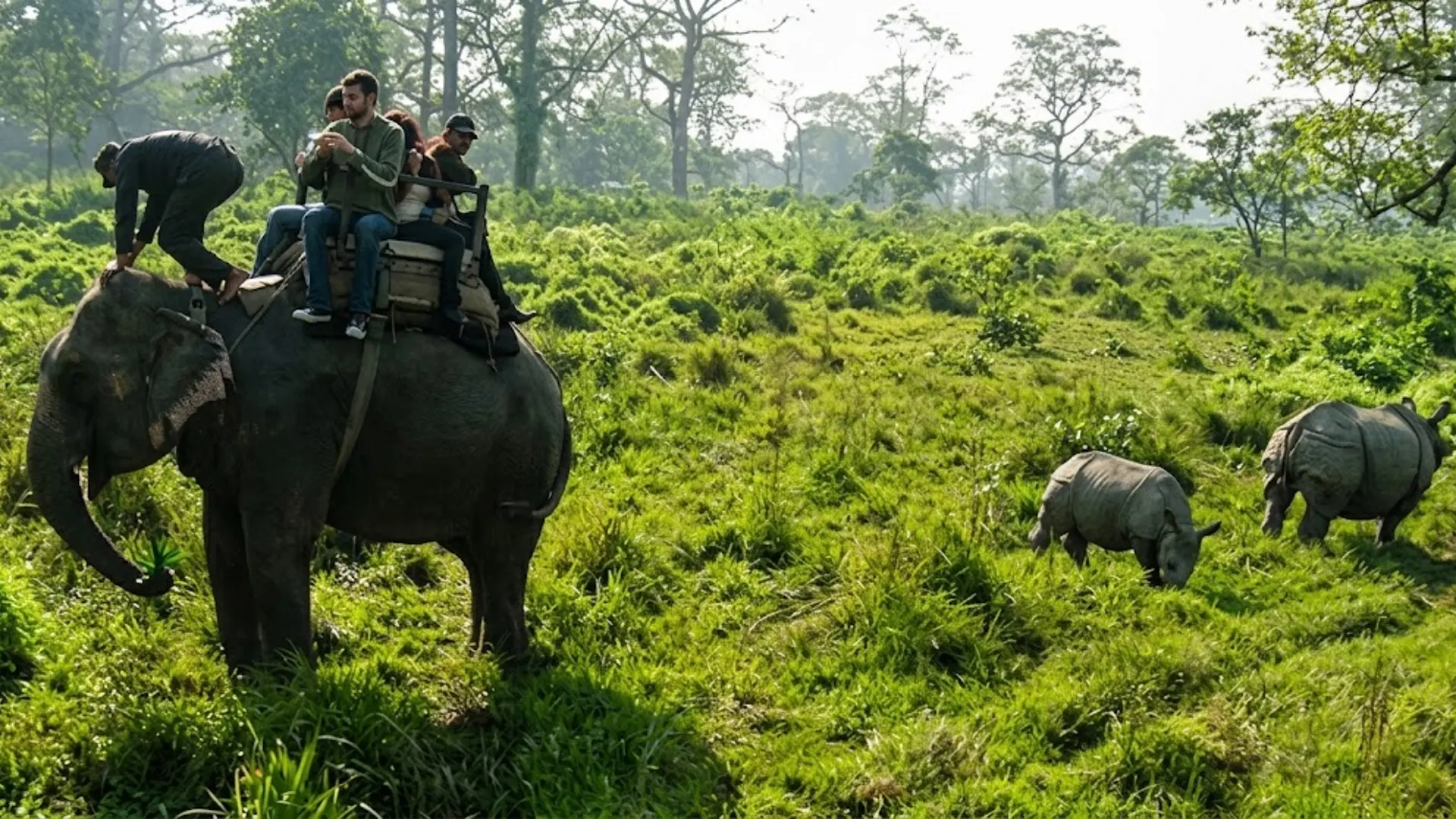
4. Elephant rides inside Chitwan National Park stopped around 15 years ago. Elephant rides were removed from the park’s core area long ago and now run only in buffer-zone community forests on the park’s edge, using privately owned animals.
5. Nepal’s Supreme Court has put elephant rides on notice. A 62-point order issued on 17 December 2025 by Justices Hari Prasad Phuyal and Tek Prasad Dhungana — full text published on the court’s website on 16 July 2026 — directs the government to reconsider elephant safaris on animal-welfare grounds and to build a managed transition toward “elephant-friendly walks”, bush walks and observation-only tourism (points 48 and 51). It is not a ban and there is no deadline. The court expressly acknowledged that elephant safaris generate income and employment in Sauraha, and ordered a phased approach rather than a shutdown.
6. The market is already moving. Sauraha’s elephant numbers have fallen from around 63 before the pandemic to roughly 44 today. Operators report that a growing share of European visitors decline rides outright and ask for a walk or a jeep instead — sometimes paying more for the hands-off option. World Animal Protection’s 2026 elephant-friendly guide lists Tiger Tops Tharu Lodge in Nepal as meeting its criteria.
Bottom line for October 2026: you can still ride an elephant in the Chitwan buffer zone, but the direction of travel is set and asking for a jeep, canoe or guided walk instead is now close to the mainstream choice rather than an awkward request.
Chitwan Is Where the Lodge Scene Lives
Chitwan has been receiving visitors since the 1960s, and the accommodation has matured with it. The result is a genuine spread of choices at the top end rather than one option with no alternative — which is exactly what makes a comparison useful.
The other thing working in Chitwan’s favour: every lodge you can actually book sits outside the park’s core boundary. A small number of historic safari lodges operated inside Chitwan in earlier decades, including the original Tiger Tops jungle lodge; those closed as the park tightened its zoning, and accommodation is now confined to the buffer zone — the villages and riverbanks along the Rapti, the Narayani and the edge near Meghauli. (Buffer-zone community forests are a legally separate area with their own activities, which is why some safari extras are described as “buffer zone” rather than “park”.) That makes which buffer zone you pick the single biggest decision you will make.
Meghauli Serai, A Taj Safari
The reference point for a luxury wildlife lodge in Nepal, and the one most first-time visitors picture when they imagine the category. It sits on the Rapti River at Meghauli, on the quiet southeastern edge of the park, roughly 45 minutes from Bharatpur Airport.
The room count is deliberately small — 29 rooms and villas in total — which is why it feels like a private estate rather than a hotel. Room categories run from river-facing rooms through pool villas to a standalone presidential villa with its own deck. The architecture stays low, thatched and open so that the property visually disappears into the grassland around it.
What sets it apart operationally: naturalists based in-house, a river-facing pool deck for the hours between drives, and the ability to run jeeps into the quieter Meghauli sector rather than joining the busier eastern gates. Elephant experiences here are observation-led rather than rides — and elephant rides have not run inside the park’s core area for around fifteen years in any case.
Kasara Resort
Also at the western buffer zone, and the strongest alternative if you want design-led comfort with serious guiding attached. Around three dozen rooms and villas, all air-conditioned — a detail that matters more than it sounds between March and May, when daytime temperatures in the Terai climb and wildlife actually improves as animals concentrate around water.
Deluxe villas come with a private water-garden courtyard and an outdoor bathroom. The larger jungle-view villas split into two bedrooms with a private plunge pool, which makes Kasara the sensible pick for families who still want the safari experience rather than a separate city hotel.
The guiding is the reason to consider it over a prettier property. Jeeps, canoe trips, bush walks and village visits are all run through in-house naturalists, and the spa and pool exist for the middle of the day when nothing moves in the forest anyway.
Barahi Jungle Lodge
The property that most resembles a wildlife lodge rather than a hotel with safari add-ons. It sits on twelve hectares of Rapti riverbank at Meghauli, directly opposite the park — and that land was bare grassland until over 5,000 trees were planted across it starting in 2012. Those trees now carry birds through the day and pull deer in at dusk, so the lodge functions as habitat rather than landscaping.
Thatched cottages with private verandas facing the river, deep soaking tubs, and full-board service. The programming leans towards the river as much as the jeep: boat safaris down the Rapti to the Narayani confluence, sundowners set up on the bank by a live kitchen, and bush dinners in a forest clearing. Morning drives leave through the Bhimle gate into the park’s quieter western corridors.
Three nights is the minimum useful stay. Two nights ticks boxes; by the third morning you are waking before the alarm because your body has already aligned itself to the forest’s schedule.
Tiger Tops Tharu Lodge
Worth knowing for context. Tiger Tops is the original Nepali safari name — the operation that pioneered jeep safaris, river safaris and the whole grammar of wildlife travel in the Terai. The original lodge inside the park closed as the boundary rules tightened; what continues, at Tharu Village on the eastern edge, is the surviving half of that lineage, along with a refuge for Nepal’s retired domestic elephants. World Animal Protection’s 2026 elephant-friendly guide lists it under Nepal on the strength of that work.
If heritage matters to you as much as thread count, this is where the history sits.
Chitwan lodge comparison
| Property | Setting | Character | Best for |
|---|---|---|---|
| Meghauli Serai (Taj) | Rapti River, Meghauli | Polished, small-scale, riverfront | Couples, honeymoons, first luxury safari |
| Kasara Resort | Western buffer zone | Design-led, air-conditioned, pools | Families, longer stays |
| Barahi Jungle Lodge | 12 ha riverbank, Meghauli | Wild-feeling, full-board, naturalist-led | Photographers, immersion |
| Tiger Tops Tharu Lodge | Eastern edge, Tharu Village | Historic, eco-oriented | Heritage, cultural depth |
Bardia Is Wilder — and the Lodge Choice Is Narrower
Here is the honest part that most Bardia safari pages skip. Bardia wins in the wilderness almost every time: fewer visitors, denser sal forest, wild elephant herds moving along the Karnali, and far fewer jeeps per sighting. On raw tiger numbers the picture changed this year — the July 2026 census put 112 tigers in Bardia against 145 in Chitwan, and Bardia was the only park surveyed to record a decline. What Bardia still offers is quiet: the same animal, with almost nobody else watching.
Finding a luxury wildlife lodge Nepal travellers can actually rely on takes more digging here — the accommodation does not match Chitwan’s depth, and pretending otherwise is how people end up in a pleasant mid-range hotel that has little to do with the park.
Tiger Tops Karnali Lodge
The property that carries Bardia’s top end. It sits beside the national park with a naturalist team running the full range of safari activity: jeep drives into the core zone, walking safaris with packs and trackers, hides positioned for patient observation, and boat safaris along the Karnali for gharial, marsh muggers and Gangetic river dolphins.
Dining happens in a traditional communal hall, with evenings around an outdoor fire. Full board is the norm rather than an add-on, which is how a remote lodge should work — the transfer cost and the flight to Nepalgunj make half-board arrangements impractical.
This is a full-day-safari property. The standard rhythm is a dawn jeep drive, a long midday break when the forest goes still, then an afternoon drive or river trip. A full-day walking safari with packed lunch, using a Land Rover to reach the remote sectors, is the version worth arranging if you have the time.
What Bardia’s field actually looks like
Beyond the headline lodge, Bardia’s accommodation runs to comfortable, locally run lodges and camps in and around Thakurdwara village — solid, well-located, well-guided, but not in the same material tier as a pool villa at Meghauli.
That is not a reason to skip Bardia. It is a reason to go with the right expectation: in Bardia you are paying for access and guides, not marble. Travellers who treat the lodge as a base rather than the destination consistently rate the experience higher than travellers comparing bathroom fittings across two parks.
Bardia also has a practical advantage Chitwan cannot offer — the park’s remoteness means guided walking safaris and machan observation hides are standard rather than rare, and you can cover ground on foot without meeting another vehicle.
What a Luxury Safari Actually Costs
Three separate bills get conflated: the lodge, the park, and the activities. Only the park fee is fixed by the government.
Park entry fees (official rates)
| Park | Nepali | SAARC | Foreigner | Child under 10 |
|---|---|---|---|---|
| Chitwan National Park | NPR 150 / entry | NPR 1,000 / entry | NPR 2,000 / entry | Free |
| Bardia National Park | NPR 100 / day | NPR 750 / day | NPR 1,500 / day | Free |
Two things that catch people out:
- Chitwan’s permit is per entry, not per trip. Three mornings in the park means three tickets. Bardia’s is per day as well, bought at the ticket counter in Thakurdwara.
- Park entry covers access only. Your guide, jeep and activities are billed separately. Chitwan also charges jeeps entering the park, currently NPR 5,000 per vehicle.
Fees are set in Nepali rupees and periodically revised — confirm the current rate at the gate or when you book. Older websites still showing NPR 1,000 for Bardia are out of date.
Safari activities (typical 2026 rates, per person, on top of entry)
| Activity | Chitwan | Bardia |
|---|---|---|
| Half-day jeep safari | NPR 2,500 – 4,000 | NPR 3,000 – 4,000 |
| Full-day jeep safari | NPR 5,000 – 8,000 | NPR 3,000 – 4,000 |
| Canoe / river trip | NPR 1,000 – 1,500 | Included with some packages |
| Guided jungle walk | NPR 1,500 – 2,500 per group | Commonly bundled |
A licensed guide is mandatory inside both parks; you cannot enter alone. Reputable lodges bundle entry, guiding and activities into a package and will show you the breakdown — ask for one in writing before paying, because double-charging for the park permit at the gate is a known complaint.
Lodge rates (observed online, October 2026)
These are published rates spotted on the booking sites for the properties named in this guide, room only, double occupancy. They move with season and availability, and they are a planning guide rather than a quote:
| Property | Observed range (per night) |
|---|---|
| Meghauli Serai, A Taj Safari | Roughly USD 250 – 700; top villas higher |
| Barahi Jungle Lodge | Roughly USD 130 – 330 |
| Kasara Resort | On request |
| Tiger Tops Karnali Lodge (Bardia) | On request, full board |
The pattern to expect: a genuine luxury lodge in Chitwan starts around USD 250 a night and climbs sharply for pool villas, while Bardia’s single headline property prices around the full-board experience rather than the room. Domestic flights between Kathmandu, Bharatpur and Nepalgunj are a separate line item and are not normally included.
Where You Stay Changes What You See
This is the section that separates a good safari from a mediocre one in the same park.
In Chitwan, the three entry zones behave differently:
- Meghauli (western buffer) — the quietest sector. Rhinos graze on the floodplain within sight of the lodges, the Rapti and Narayani confluence draws crocodiles, dolphins and birdlife, and you share the track with very few other jeeps. This is where the luxury lodges cluster, and that is not a coincidence: they were built there because the wildlife came to them.
- Sauraha (eastern edge) — the busiest gateway. Maximum convenience, the full range of shops, restaurants and activity operators, and a busy queue at the park gate at 06:00. Better for a short trip with non-safari interests mixed in; worse if solitude is the point.
- Barauli and the western buffer — quieter still, more rural, fewer facilities, strong for birdlife.
In Bardia, the calculation is simpler: almost everything is anchored around Thakurdwara at the park’s eastern gate, so your choice is about lodge quality and guide quality rather than sector. The park itself is large enough that two different jeeps can work entirely different corridors on the same morning.
The rule that follows from this: pick the lodge by the ground it puts you on first, and by the room second. Two nights at a modest lodge in the right sector beats three at a beautiful one in the wrong one.
Best Time for a Luxury Safari in Nepal
| Season | Months | What it’s like | Who it suits |
|---|---|---|---|
| Cool & dry | October – February | Comfortable days, cold nights, clear light, prime birding | Everyone; peak demand, book lodges early |
| Hot & productive | March – May | 30°C+, animals at waterholes, strong tiger viewing, lodges run A/C | Wildlife-focused travellers who don’t mind heat |
| Monsoon | June – September | Lush, green, rain, some lodges close, limited park access | Birders and photographers chasing greens; lowest rates |
March and April are the months safari guides quietly point to for tigers: the grass thins, water sources shrink, and animals that spent the wet months hidden are predictable. The trade-off is heat — which is precisely why the top lodges’ air-conditioning and pools stop being luxuries and start being the plan for the middle of the day.
Bardia’s season follows the same shape but runs slightly shorter for walking safaris, and the far-west parks close more firmly during the heaviest monsoon weeks.
Doing Chitwan and Bardia in One Trip
With eight days or more, the combination is the strongest Nepal safari itinerary on offer — two genuinely different ecosystems rather than two versions of the same one.
The routing that works:
- Kathmandu → Chitwan (25-minute flight to Bharatpur, or a road transfer) — 3 nights.
- Chitwan → Kathmandu → Nepalgunj (domestic flight, about an hour) — same day if timings align.
- Nepalgunj → Bardia (road transfer of about three hours to Thakurdwara) — 4 nights.
- Nepalgunj → Kathmandu — onward international connection.
Total: 8 days on the ground with domestic flights stitched in. Do it in that order rather than in reverse: Chitwan’s easier access and higher sighting frequency gets you acclimatised to reading the forest before you move to a park where patience matters more.
Build the three-hour Nepalgunj transfer into your plan rather than treating it as a formality — it is the longest single movement of the trip, and it is the reason Bardia gets fewer visitors than it deserves.
Both legs are safari-led, so the second park does not feel like a repeat — different guiding style, different habitat, different species emphasis. Bardia adds wild elephants, a stronger river system and walking safaris that Chitwan’s visitor numbers make harder to run well.
Which Park Is Right for You?
Choose Chitwan if you are: - Taking a first safari in Nepal and want the highest chance of seeing rhino — 694 were recorded in the park in the 2021 census, over 92% of Nepal’s national total - Travelling with children or older relatives who value shorter transfers and better facilities - Short on time (3 nights fits almost any Nepal itinerary) - Photographing birds — 500+ species in the park - Wanting a genuine luxury lodge rather than a comfortable base
Choose Bardia if you are: - On a second or third Nepal trip and want somewhere genuinely quiet - Interested in walking safaris and machan observation hides, not just jeep drives - Comfortable with a domestic flight and roughly a three-hour road transfer - Happy trading resort facilities for forest - Drawn to the far west for its wild elephants and the Karnali river system
Do both if you: - Have 8+ days - Want rhinos and wild elephants in the same itinerary - Are a serious photographer planning around light and season
Be realistic about tigers in either park: no safari can guarantee one. The July 2026 census recorded 145 tigers in Chitwan and 112 in Bardia, and both parks are large enough that a sighting depends on season, luck and the skill of your guide far more than on which gate you enter from.
How to Choose a Luxury Wildlife Lodge in Nepal
The category label luxury wildlife lodge Nepal is used loosely, and most operators apply it to any hotel with a pool and a jeep excursion. These are the questions that separate the two:
- Are naturalists in-house, or outsourced? A lodge with its own naturalist team builds continuity — the same person reads your interests across three mornings and adjusts. Agencies dispatched each day do not.
- Which gate does it use, and how far is it? Anything over 45 minutes to the gate costs you sighting hours every single day.
- Is the park entry fee included? It is not always, and it is a real line item at the top end.
- What does full board actually cover? In a remote location, dinner is not optional. Confirm it before booking.
- How many rooms? Under 40 rooms usually means a better guide-to-guest ratio and a quieter property.
- What is the elephant policy? Elephant rides stopped inside Chitwan’s core area around fifteen years ago, and a Supreme Court order dated 17 December 2025 has since directed the government to build a managed transition toward observation-only and elephant-friendly walks. Rides still operate in buffer-zone community forests for now. Ask directly whether the elephants on your route are ridden or walked alongside — the better lodges will answer without hesitating.
- When does it close? Some properties shutter through the heaviest monsoon weeks. Confirm your dates fall inside the operating season.
- Can someone check current rates and availability for your dates? Lodge rates move sharply with season and there is no reliable public price list. Ask before you commit to anything.
Ethical Wildlife Tourism: What to Ask Before You Book
Nepal’s legal position on wildlife tourism moved during 2026, and a lot of operator websites have not caught up. Four questions worth putting to any lodge or agency before you pay:
- “Do your elephant experiences involve riding?” Elephant rides no longer run inside Chitwan’s core area. They continue in buffer-zone community forests using privately owned animals, and the Supreme Court’s 17 December 2025 order has directed a managed transition away from them. A lodge that answers this instantly and clearly is telling you something about how it runs everything else.
- “Is your park fee included, and is your guide licensed?” A licensed guide is mandatory inside both parks. Some operators bundle the permit and then re-charge it at the gate. Ask for a written breakdown.
- “Do your naturalists work for you, or for a dispatch agency?” In-house naturalists mean the same person reads your interests across three mornings. It also means the lodge is investing in the wildlife, not just the linens.
- “What do you do when a sighting gets crowded?” On a busy morning in Chitwan’s eastern gates, the ethical answer is to move rather than to crowd. Ask how guides handle a rhino with four jeeps already on it.
What ethical practice looks like in practice in 2026: jeep safaris, canoe trips on the Rapti and Narayani, guided jungle walks with a licensed tracker, machan observation hides, riverboat trips on the Karnali, and — where elephants are involved at all — bush walks alongside the animal rather than a ride. World Animal Protection’s 2026 elephant-friendly guide recognises Tiger Tops Tharu Lodge in Nepal on exactly this basis.
None of this means a lesser safari. The jeep, the canoe and the walking safari between them see more wildlife per hour than an elephant ride ever did, because gharial, rhino and birdlife concentrate along the water a boat reaches quietly.
Why Book Your Nepal Safari with Nepal Lion Tours
We plan safaris in both parks and will tell you plainly which one fits your dates, group and priorities — including when the answer is “neither, not in this season.”
- Government-licensed, English-speaking guides with practical wildlife and route knowledge on every departure
- A registered trekking company you can verify — Reg. No. 184920/074/075, based in Thamel, Kathmandu; member of the Nepal Tourism Board, TAAN, KEEP and the Thamel Tourism Development Council. Documents available on request
- Wilderness first-aid trained guides and group leaders — a standard we hold on safari as well as on the trail
- Private departures from two travellers — your dates, your pace, no group-tour schedule
- A local team you can contact before and during the trip — one point of contact from enquiry to return
- Transparent inclusions and exclusions, with permits and entry fees handled as part of your preparation
- Language-speaking leaders available on request — French, German, Spanish, Russian and Japanese, arranged in advance
Tell us your dates and which park you are leaning towards, and we will come back with lodge availability, current rates and a day-by-day plan for both options.
Send your preferred travel date and group size through the booking form or WhatsApp at +977-9851039020.
Whether you’re travelling solo, as a couple, with friends, or with family, we’ll help you plan a safari that works.
Your first rhino sighting on the Rapti is waiting — choose your dates and start planning today.
Frequently Asked Questions
Q. Is a luxury wildlife lodge in Nepal worth the cost?
+
Yes, if you are staying three nights or more — and only if the lodge sits in the right sector. The premium buys you in-house naturalists, a shorter run to the gate, air-conditioning through the hot months, a pool and spa for the dead middle of the day, and a property quiet enough that wildlife comes to you rather than the other way round. On a two-night stay, almost none of that has time to pay off. Three nights is the break-even point.
Q. Which is better for tigers, Chitwan or Bardia
+
It is genuinely close now, and the answer changed in 2026. The national tiger census released on 29 July 2026 recorded 145 tigers in Chitwan and 112 in Bardia — and Bardia was the only park in Nepal to record a decline, down from 125 in 2022. Across similar areas, Chitwan’s density is now higher. Bardia’s remaining advantage is quieter forest and far fewer jeeps per sighting, not more tigers. Neither park will guarantee a tiger; anyone promising that is selling something.
Q. Which is better for first-timers, Chitwan or Bardia?
+
Chitwan. The transfers are shorter, the lodges are stronger, and it holds over 92% of Nepal’s one-horned rhinos, which is the sighting most first-time visitors come for. The surrounding infrastructure handles first-time visitors properly. Bardia rewards people who already know what a safari day feels like.
Q. What are the park entry fees?
+
As of October 2026, Chitwan charges NPR 2,000 per foreign visitor per entry (NPR 1,000 for SAARC nationals, NPR 150 for Nepalis), and the permit is per entry — three park mornings means three tickets. Bardia charges NPR 1,500 per foreign visitor per day (NPR 750 SAARC, NPR 100 Nepali) at the ticket counter in Thakurdwara. Children under 10 enter free in both parks. Entry covers access only; your guide, jeep and activities are billed separately.
Q. How many days do I need for a Nepal safari?
+
Three nights minimum in one park. Four nights in Bardia if tigers are the priority. Eight days if you want to combine Chitwan and Bardia with the domestic flights between them.
Q. Do I need a domestic flight for a luxury safari in Nepal?
+
Not for Chitwan — a 25-minute flight to Bharatpur or a road transfer from Kathmandu covers it. Bardia normally requires a flight to Nepalgunj (about an hour) followed by a road transfer of roughly three hours to Thakurdwara. Internal flights are not included in safari pricing by default; they are booked separately.
Q. Are elephant rides still available in Chitwan?
+
Technically yes, but only in the buffer-zone community forests on the park’s edge — elephant rides stopped inside Chitwan’s core area around fifteen years ago. A Supreme Court order dated 17 December 2025, whose full 62-point text was published on 16 July 2026, directs the government to reconsider elephant safaris on welfare grounds and to develop a managed transition toward observation-only and elephant-friendly alternatives. It is not an immediate ban, and no deadline has been set. Sauraha’s elephant numbers have already fallen from around 63 before the pandemic to roughly 44 today, and asking for a jeep, canoe or guided walk instead of a ride is now close to the mainstream choice.
Q. What does a luxury safari in Nepal cost?
+
It moves with season, lodge, group size and length of stay. As a planning guide from October 2026: park entry for a foreign visitor runs NPR 2,000 per entry in Chitwan and NPR 1,500 per day in Bardia; a full-day jeep safari in Chitwan is around NPR 5,000–8,000 per person; and room rates at the lodges in this guide start at roughly USD 130 a night, with Chitwan’s top properties from about USD 250 and pool villas higher still. Domestic flights are separate. We do not publish fixed rates because they change with availability — ask us for a current quote for your dates and we will give you the full cost with park fees, guiding and transfers itemised.
Q. Can we do Chitwan and Bardia in one trip?
+
Yes, and it is the strongest safari itinerary Nepal offers. Allow eight days: three nights in Chitwan, then a domestic flight via Kathmandu to Nepalgunj for a road transfer of about three hours, and four nights in Bardia. Doing it in that order gives you the easier, higher-frequency park first.
Admin
A passionate explorer and writer dedicated to sharing authentic stories, local insights, and expert travel guides from the heart of the Himalayas.
No comments yet
Be the first to share your thoughts and experiences on this story!